The Life of a Data Scientist

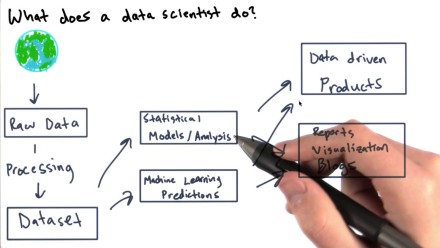
The worldwide demand for qualified Data Scientists continues to grow and one of the most common queries in many an industry insider’s mind is so, what is it that a Data Scientist does? When lay persons within an industry try to grasp the essence of a Data Scientist’s life, the confusion that boggles everyone is that this unique profession cannot be linked to one particular trade, one particular academic degree, or a single organizational role. Rather, the Data Scientist’s role is to identify and solve day-to-day business problems through a multi-disciplinary approach that encompasses many different skills like mathematics, statistics, computer science, operational research, and of course, business.
In a way, the Data Scientist’s job is to first understand the existing business processes, then identify the underlying problems, and then attempt reaching solutions through data-driven technologies to streamline the processes for better business gains. It is common to find Data Scientists arriving on the job from widely disparate academic backgrounds and experience levels—Machine Learning and programming, theoretical statistics and modeling, and also conventional mathematics fields. When these persons enter the Data Science field, they all display one common characteristic—a tremendous curiosity to unravel the mystery behind business data.
The most important qualifier that distinguishes Data Scientists from their professional peers is the superior ability to deliver algorithms that promise to solve business problems. In fact, the Data Scientist’s greatest motivation is to solve enterprise-level process problems through data-enabled systems and tools, which even the non-data experts can use in their daily business lives. The Data Scientist rejoices when his or her solutions help solve real world problems.
The second-most important aspect of a Data Scientist’s job is the “cross-functionality” of project execution. In Data Science, a large amount of work time must be invested in aligning business goals with technology goals. In a large enterprise with competing team agendas, the job of aligning teams across business groups, analytics teams, and technology experts can be a real challenge.
As Forbes tries to review the Data Scientist position as currently is use in the US, they use Glassdoor as a reliable source of career-rating services, to collect feedback about the Data Scientist position. In the 2016 Glassdoor report that rates careers based on salary structures, career advancement prospects, and professional status, Data Scientist occupies the top rank. The majority of Data Science employees surveyed by Glassdoor have responded that the appeal of delivering highly visible, real-world solutions is the biggest incentive for the data professionals. These professional have also commented that around 80% of their work time is spent on data cleansing and data preparation while only 20% is spent on executing solutions. In this context, one may want to review the article Diversity in Data Science Jobs.
An Umbel blog post tries to describe the Data Scientist’s life in terms of tasks performed at different times of the day. This post explains that in a typical work day, mornings are filled with meetings and networking to discuss problems and report progress. Post meetings, the teams could be spending time on data research, exploration of statistical procedures, or modeling. Afternoons can be dedicated to client consultation or business development activities. At the end of the day, the work teams generally meet to discuss the achievements of the day.
This Booz Allen newscast reveals that the an average Data Scientist spends most of the work time in understanding data, detecting patterns, developing algorithms, and writing programs to answer the queries that users have about the business data. Many times, these different tasks cannot be fulfilled by a single scientist; so Data Science professionals are commonly seen to be working in team environments where distinct individuals bring distinct expertise to fulfill a common goal.
A Rutger’s University article titled A Day in the Life of a Data Scientist makes some interesting observations as follows:
- The Data Scientist’s life can vary a great deal depending on the business needs and the actual working conditions.
- The key skill required for success on the job is a keen understanding of the “data.”
- As evolving Data Scientists will continually need to communicate best practices to their peers, they need to acquire superior communication skills.
src: dataversity.net